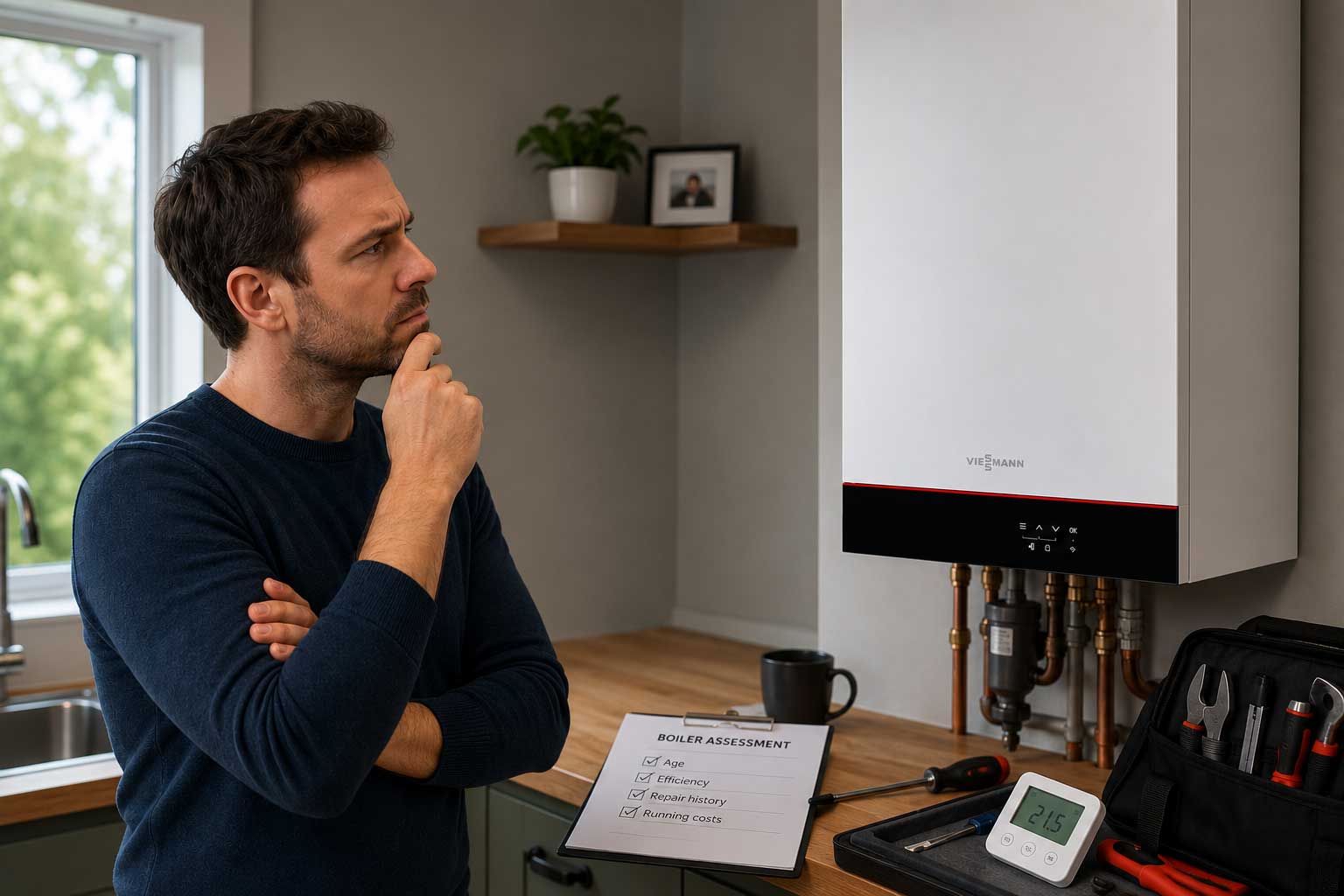
If your boiler has started breaking down more frequently, you’re probably asking yourself the same question many Irish homeowners face:
“Should I repair my boiler, or is it time to replace it?”
It’s rarely an easy decision. While repairing a boiler is often the cheaper option in the short term, continuing to repair an ageing or inefficient system can sometimes cost more over time than investing in a replacement.
The right choice depends on several factors, including the age of your boiler, the cost of repairs, its efficiency, the availability of replacement parts and how reliable it has been over the years.
This guide will help you weigh up the pros and cons so you can make an informed decision.
Table of Contents
- How Long Should a Boiler Last?
- When Is Repairing Your Boiler the Better Option?
- When Is It Time to Replace Your Boiler?
- The Hidden Cost of Keeping an Old Boiler
- Five Questions to Help You Decide
- Repair vs Replace: A Quick Comparison
- Should You Consider a Heat Pump Instead?
- Frequently Asked Questions
- Still Unsure Whether to Repair or Replace Your Boiler?
How Long Should a Boiler Last?
A well-maintained boiler can provide many years of reliable heating and hot water.
As a general guide:
- Modern condensing gas boilers typically last 10–15 years.
- Oil boilers often have a similar lifespan, although some well-maintained systems can continue operating for longer.
However, age alone shouldn’t determine whether a boiler should be replaced. We’ve seen relatively new boilers suffer major faults, while older systems continue to operate reliably with regular servicing.
The condition of the boiler, how often it has been serviced and its repair history are usually better indicators than its age alone.
When Is Repairing Your Boiler the Better Option?
In many cases, repairing your existing boiler makes perfect financial sense.
A repair is often the better option if:
- Your boiler is less than 10 years old.
- This is the first significant fault you’ve experienced.
- The repair involves replacing a common component such as a pump, fan, pressure sensor or valve.
- Replacement parts are readily available.
- The boiler has otherwise been reliable and efficient.
- A qualified heating engineer expects many more years of reliable service after the repair.
If these conditions apply, repairing your boiler could be the most economical solution.

When Is It Time to Replace Your Boiler?
There comes a point where replacing a boiler becomes the more sensible long-term investment.
Some common signs include:
Your Boiler Is Reaching the End of Its Life
If your boiler is approaching 15 years old, it may be nearing the end of its expected lifespan.
Even if it can still be repaired, other components may begin to fail over the coming years.
You’re Paying for Frequent Repairs
An occasional repair is perfectly normal.
However, if you’re calling an engineer every winter, repair costs can quickly add up.
Multiple breakdowns often indicate that the entire system is beginning to wear out rather than suffering from a single isolated fault.
Spare Parts Are Becoming Difficult to Find
Manufacturers eventually discontinue parts for older boilers.
When replacement components become difficult—or impossible—to source, repairing the boiler may no longer be practical.
Your Heating Bills Keep Increasing
Older boilers are generally less efficient than modern condensing models.
If your fuel consumption has steadily increased despite similar heating habits, replacing an inefficient boiler could reduce your running costs over time.
Reliability Is Becoming a Concern
For many homeowners, reliability is just as important as efficiency.
If you’re constantly worried about losing heating or hot water during winter, replacing the boiler may provide valuable peace of mind.
The Hidden Cost of Keeping an Old Boiler
Most people just compare the price of a repair to the price of a new boiler.
Many people compare the cost of a repair to the cost of a new boiler, but they do not realise that there are many hidden costs of an old boiler.
These can include:
- Increasing repair bills.
- Higher fuel consumption due to reduced efficiency.
- Emergency call-out charges.
- Time without heating or hot water.
- Difficulty sourcing replacement parts.
- Greater likelihood of future breakdowns.
When compared to the cost of repairing a defective component, over a number of years these ‘additional’ costs can, on occasion, be greater than the difference between the cost of repair and replacement for a boiler of some age.
Five Questions to Help You Decide
Here are 5 questions to help you decide if you should have your boiler repaired or replaced.
1. How old is my boiler?
Just because a boiler is old does not mean that it has to be replaced. However, the age of a boiler should be a consideration in your overall decision.
2. Has it broken down more than once recently?
Recurring faults on a boiler indicate that it is starting to deteriorate rather than developing one isolated problem that can be repaired.
3. Are spare parts still available?
Spare parts may become difficult to source for an older boiler, which will lead to expensive repairs.
4. Are my heating bills increasing?
A less efficient system will push up your annual heating bill. This is especially noticeable in cold winters.
5. How long do you intend to live in your property?
Is your plan to stay in your home for a number of years? It will be cost-effective in the long run to invest in a modern, efficient boiler.
Repair vs Replace: A Quick Comparison
| Repair Your Boiler | Replace Your Boiler |
|---|---|
| Lower upfront cost | Higher initial investment |
| Ideal for newer boilers | Improved energy efficiency |
| Retains your existing system | Greater long-term reliability |
| Suitable for isolated faults | Manufacturer warranty |
| Usually quicker to complete | Lower likelihood of future breakdowns |
Neither option is always the right answer.
The decision between repair and replacement will also depend on the current state of your existing boiler and your individual circumstances.

Should You Consider a Heat Pump Instead?
Even if your boiler is approaching the end of its life then it’s worth finding out whether or not a heat pump would be suitable for your home.
While a Heat Pump is not suitable for every home, recent advancements in the system’s design have made them a very viable option for many Irish Homeowners. With the grants that are currently available it may also be worth exploring as an alternative to replacing your existing Boiler when it reaches end of life.
A professional assessment will tell you whether a Heat Pump is suitable for your home. It will also outline the estimated running costs compared to your current boiler.
Frequently Asked Questions
Should I replace a 15-year-old boiler?
Not necessarily. If the boiler remains reliable, efficient and replacement parts are readily available, repairing it may still be worthwhile. However, repeated breakdowns or increasing repair costs often make replacement the better long-term option.
Is it worth repairing a leaking boiler?
It depends on the cause of the leak. A leaking valve or seal may be a straightforward repair, whereas a leaking heat exchanger can be significantly more expensive and may make replacement the more economical choice.
How many times should a boiler be repaired?
There isn’t a fixed number. Occasional repairs are part of normal ownership, but repeated breakdowns over a short period usually indicate that replacement should be considered.
Can old boilers still get spare parts?
Many can, but manufacturers eventually stop producing replacement components. Availability depends on the make, model and age of the boiler.
Is replacing a boiler always cheaper in the long run?
Not always. A newer boiler with a single repair is usually worth fixing. Replacing a boiler makes more financial sense when repair costs become frequent, efficiency declines or reliability becomes a concern.
Still Unsure Whether to Repair or Replace Your Boiler?
Every heating system is different, which is why there’s rarely a simple yes-or-no answer.
The most cost-effective decision depends on the condition of your boiler, the nature of the fault and how long you expect the system to continue providing reliable service.
At NRM Plumbing & Heating, we provide honest, practical advice based on the condition of your existing heating system. If a repair is the most sensible option, we’ll tell you. If replacing the boiler is likely to save you money and reduce future problems, we’ll explain why and recommend suitable replacement options.
Whether you need a boiler repair, a replacement boiler or simply professional advice, our experienced team is here to help. Contact NRM Plumbing & Heating today to arrange an inspection and discuss the best solution for your home.








Leave A Comment