If you are replacing an old hot water cylinder, it is tempting to order the same size again and leave it at that. Sometimes that is exactly the right decision. Sometimes it simply repeats a problem you have lived with for years.
Perhaps the hot water regularly runs out after two showers. Maybe the children have grown up and moved out, leaving you heating far more water than you now use. You may also be changing the boiler, adding an ensuite or considering a heat pump. Any of those changes can affect the cylinder you need.
For an initial guide, a one or two-person household will often look at cylinders around 120–150 litres. A typical family may be closer to 180–210 litres, while a busy home with several occupants, more than one bathroom or a large bath may need 250–300 litres.
Those figures are starting points. The right answer depends on where your hot water goes, how quickly it is used and how quickly the system can heat it again.
Table of Contents
- Are Hot Water Cylinders a Standard Size?
- What Size Hot Water Cylinder Do I Need?
- Start With Your Busiest Hour
- Which Showers Actually Use the Cylinder?
- How Much Difference Does a Bath Make?
- Capacity Is Only Half the Story
- The Cylinder Must Suit the Heating System
- Will the Replacement Fit?
- Is Bigger Always Better?
- Can You Replace the Old Cylinder Like for Like?
- What NRM Will Check Before Recommending a Cylinder
- Frequently Asked Questions
- Need a Hot Water Cylinder Replacement in Dublin?
Are Hot Water Cylinders a Standard Size?
No. There is no single standard cylinder that suits every Irish home.
Domestic cylinders come in a range of capacities, commonly including 120, 150, 180, 200, 210, 250 and 300 litres. The exact sizes depend on the manufacturer. Vaillant’s current uniSTOR range, for example, runs from 120 to 300 litres.
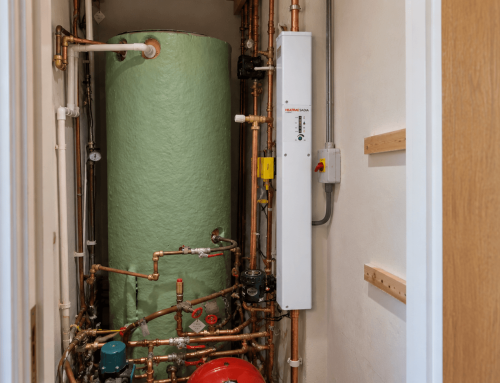
Capacity is not the same as physical size. Two 200-litre cylinders may have different heights and diameters because of their insulation, casing and internal design. Slimline cylinders use less floor space but are generally taller.
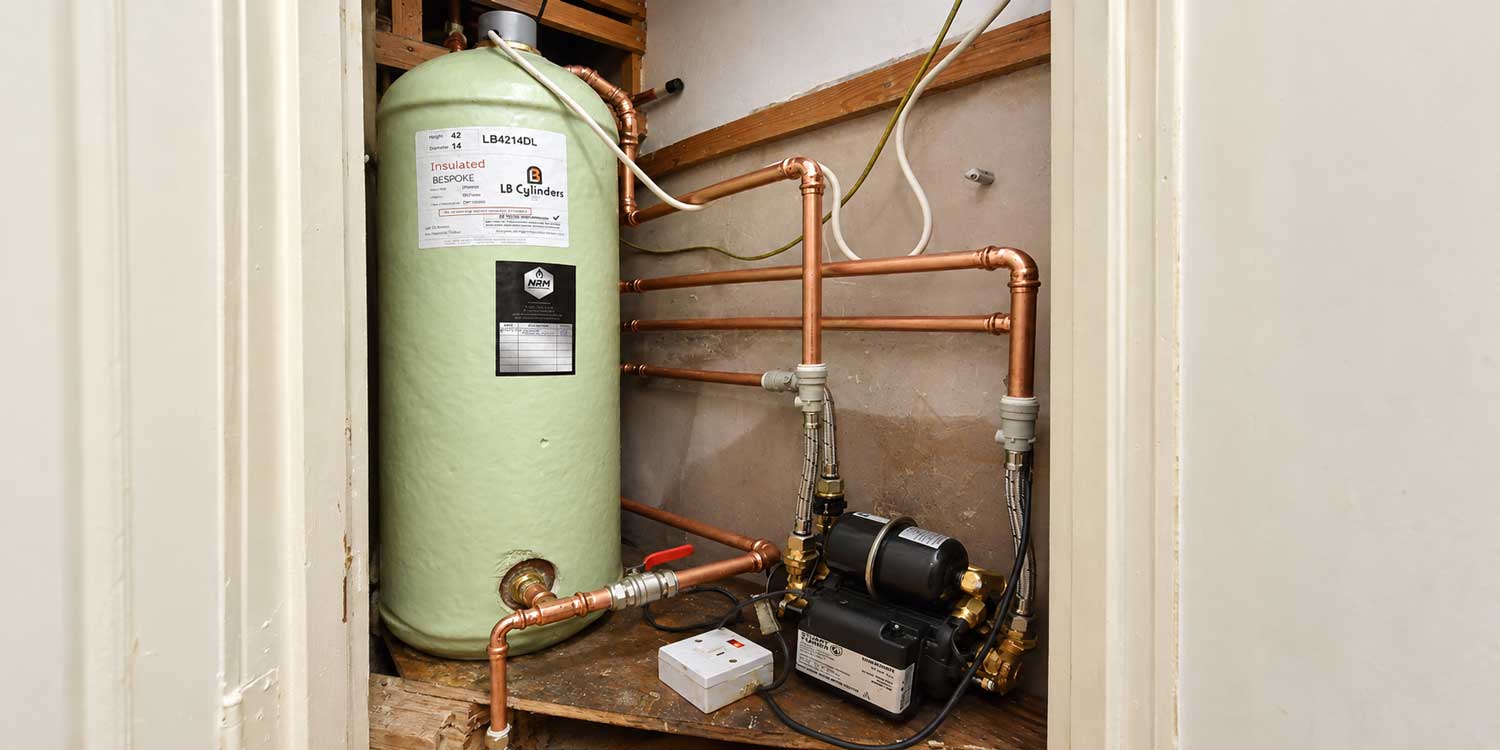
Older copper cylinders are often described by height and diameter in inches. Those measurements help identify what is there, but a modern replacement may hold a different amount within a similar space. The household’s needs may also have changed since the original was fitted.
What Size Hot Water Cylinder Do I Need?
This table gives a sensible place to begin. It is not a final specification, because shower type, bath use and reheating time can move a household up or down a size.
| Household and typical use | Capacity to consider |
|---|---|
| 1–2 people, one bathroom and mainly showers | 120–150 litres |
| 3–4 people, regular showers and occasional baths | 180–210 litres |
| 4–5 people, higher use or more than one bathroom | 210–250 litres |
| 5+ people, large baths or overlapping bathroom use | 250–300 litres or a designed alternative |
A cylinder is storing hot water for the moments when demand is at its highest. For that reason, the number of people in the house is useful, but it is not enough on its own.
Take two families of four. In one home, both showers are electric and heat cold water as it passes through the shower unit. In the other, two mixer showers draw from the hot water cylinder. The second family can empty its stored supply much faster even though the number of occupants is identical.
Start With Your Busiest Hour
Think about what happens on a normal weekday morning rather than trying to calculate a whole day’s use.
Do three or four people shower one after another? Does somebody fill a bath while another person uses hot water in the kitchen? Are both bathrooms likely to be used at the same time? That short period of heavy use usually matters more than the total number of taps in the house.
Timing matters too. A household using most of its hot water between 7 am and 8 am needs enough storage, or quick recovery, to cover that hour. Where showers are spread through the day, the cylinder can reheat between uses.
This is why choosing by bedroom count can be misleading. A three-bedroom house occupied by two people may need less hot water than a two-bedroom home shared by four adults.
Tell the installer how the household actually works. Regular guests, teenagers and shift work can all change the pattern of demand.
Which Showers Actually Use the Cylinder?
One of the first questions should be whether each shower is electric, mixer or pumped.
Electric Showers
A standard electric shower takes cold water and heats it inside the shower unit. It normally uses no stored hot water at all.
If your main shower is electric, the cylinder may only supply taps and an occasional bath. That can reduce the storage needed compared with a home where every shower draws from it.
Mixer Showers
A mixer shower combines hot water from the cylinder with cold water. The faster the shower flows and the longer it runs, the more quickly it uses the stored supply.
Large rain heads and high-flow fittings may use much more water than an ordinary shower head. A cylinder that coped before a bathroom renovation can suddenly feel too small.
Power Showers
A power shower also draws hot water from the cylinder and uses a pump to increase the flow. The stronger flow can use stored water quickly, so both the cylinder and the existing plumbing need to be considered.
If two cylinder-fed showers may run together, a larger store could be needed. The supply must also deliver the required flow; more capacity will not fix undersized pipework or weak mains flow.
How Much Difference Does a Bath Make?
A standard bath is likely to generate a single higher demand than a shower and a very deep bath, possibly freestanding, could be bigger still.
Not all the liters listed for a bath will come from the cylinder. There is the water mixed with hot to fill the bath, often not filled to the top and the person getting into the bath will use up some of the water already in the bath.
When a bath is used in combination with two showers, the shower use must be covered by the storage tank or re-heated within a suitable timeframe. A bath used from time to time would generally have less influence on the decision than regular use.
If you are planning a bathroom refurbish and require a larger bath then ensure the cylinder can be fitted prior to the refurbish of the bathroom.
Capacity Is Only Half the Story
A 200 litre cylinder will hold 200 litres of water but that does not tell you how fast it will supply hot water.
Recovery time will depend on several factors including the type of heat source, the type and size of the cylinder coil, the temperature and quality of the cold water incoming to the cylinder and the controls fitted to the cylinder.
A smaller cylinder with a good high recovery rate may be a better option where there are a number of users and water is used at distributed times throughout the day. A larger cylinder, however, may give only marginally better performance and still reheats frequently and never seems to have enough hot water for the morning washes.
Your distribution partner should tell you how long it will take for a given cylinder to recover with a given boiler, immersion or heat pump. The figures published by the manufacturer for recovery should always be read against the specific conditions in which they were tested.
It is also worth noting that the nominal capacity of the cylinder is not the same as the actual amount of shower-temperature water stored. When the water is stored hot it will be mixed with cold from the shower or bath and the amount of usable water will depend on the storage temperature and the temperature of the cold water inlet.
The Cylinder Must Suit the Heating System
Even once you have established the approximate capacity of water for heating for your home, the cylinder must still fit the system.
Vented or Unvented
A Vented Cylinder is normally supplied from a cold water storage tank located in the attic. The pressure in the outlets will depend on the height of the storage tank and the pipework down to the Cylinder.
An unvented cylinder can be suitable for strong delivery of water (especially in systems without pressure issues) provided there is sufficient pressure and flow to meet requirements. However, supply must be tested and a suitable safety-discharge route required.
Direct or Indirect
This type of cylinder uses one or more immersion elements to directly heat the water.
Many homes have a dual immersion marked “sink” and “bath”. The shorter element is designated as “sink” and heats the upper part of the cylinder which supplies the same amount of hot water as a normal hot water tank. The longer element is designated “bath” and heats the lower part and majority of the cylinder water.
An indirect cylinder is heated via a heating coil that is connected to a gas boiler or oil boiler. These types of cylinder are often supplied with an immersion as a backup. Therefore the coil must be compatible with the boiler and must be able to achieve the required recovery time to the water in the cylinder.
Heat-Pump Cylinders
Cylinders for heat pumps are designed with larger heat-exchanger coils for these systems and the size appears to be suitable for a hot water cylinder but in reality they are not compatible with existing boiler cylinders even though they appear to be the correct size. Vaillant’s uniSTOR heat-pump cylinders are an example of this type of cylinder.
Indicate if you have plans to install a heat-pump in the next couple of years or so. This will indicate if a larger cylinder with specific larger heat-exchanger coils would be more suitable at the time of installation.
Solar Thermal and Solar PV
Solar thermal panels must have a twin-coil cylinder to operate adequately in conjunction with a boiler or other heat source.
They need to be able to send electricity to an immersion heater, via suitable controls. Thus, no solar thermal coil is required for PV systems alone.
Will the Replacement Fit?
Measuring the new cylinder’s outside dimensions, as well as its “litter” capacity when housed in a hot press, is crucial to confirm whether the replacement cylinder will actually fit.
Measure around the cupboard space, the door opening, and the route through the house. This will help establish if the cylinder can get round stairs, landings, etc., before it enters the hot press.
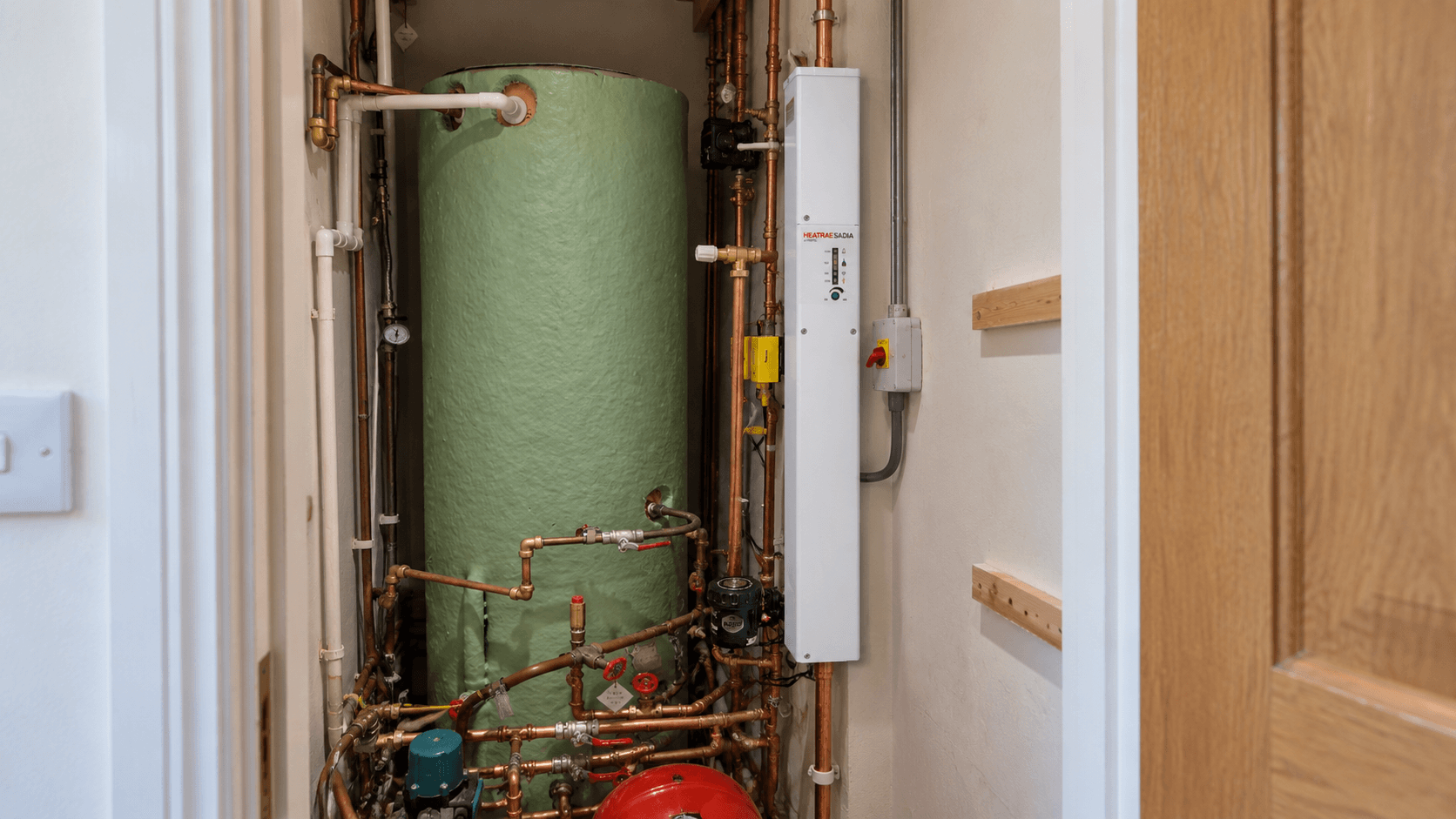
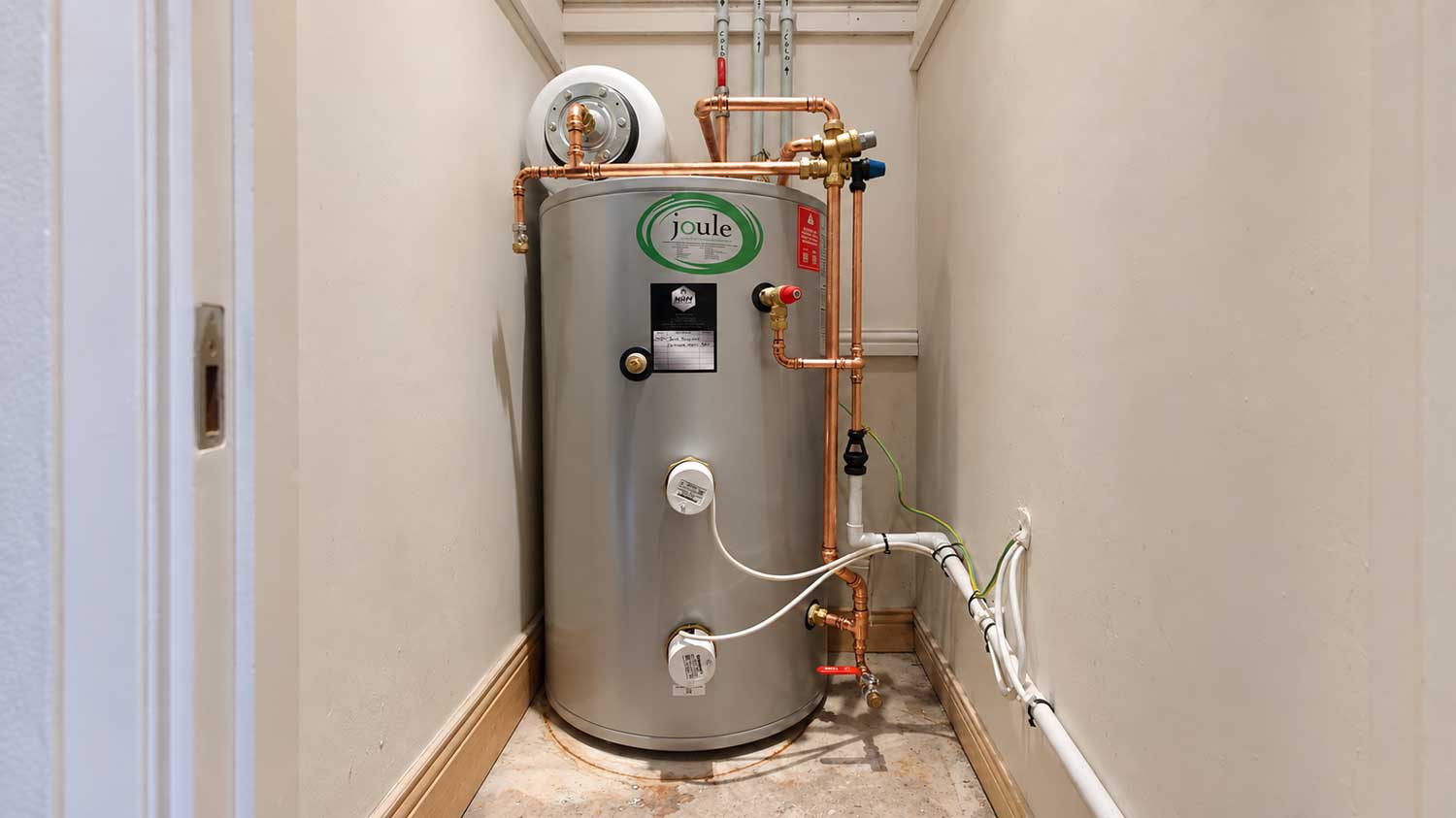
The Cylinder must also have room for pipes, and for valves and thermostats controlling the system. If you’re installing an unvented system, extra safety components will be required. Many Heat-Pump cylinders are larger than the normal systems that they replace.
An installer will normally check:
- Height, width and depth of the available space.
- Doorways and the access route through the property.
- Pipe positions and room for valves and controls.
- The condition and strength of the supporting floor.
- Access for future maintenance.
- The manufacturer’s required clearances.
A slimline version of a cylinder may provide a solution to floor-space problems but will be tall not horizontal. Standard vertical hot water cylinders cannot simply be laid on their side.
Is Bigger Always Better?
No, having the biggest cylinder that will fit in the space is not necessarily better. While there must be some reserve capacity, you don’t need to over-specify.
If the new cylinder is too small to hold enough hot water for the busiest period of the year plus a small reserve, problems arise: The showers get cold, the bath fillings have to be interrupted by cold water or everybody has to wait till the water has been reheated.
Yes, it costs more, it uses up space and then, because it is so much larger, it loses more heat through its external surface. Even with very good insulation, there is little point in storing hot water that will be used very occasionally by the household.
It is a difficult balance to hit but ideally a cylinder should hold enough for the busiest normal usage period plus a little margin, without storing too much water that is rarely hot enough for use.
Frequently Asked Questions
What Size Hot Water Cylinder Does a Family of Four Need?
For a family of four, a good starting point would be around 180-250 litres. As previously mentioned, a family with electric showers will probably need less capacity than a family using mixer showers.
Recovery time must be considered.
Is a 150-Litre Cylinder Big Enough?
Capacity of 150L for 1/2 people, using electric showers for bathing with occasional use of hot water stored in cylinder for washing up etc.
Is a 200-Litre Cylinder Enough for Four People?
Generally, a 200litre bath tank would be suitable for a family of four, provided that they use water reasonably and that the cylinder is able to reheat satisfactorily. Showers longer than about 5 minutes, baths larger than average and two bathrooms used simultaneously are all likely to require a 300litre bath tank or more.
Does an Electric Shower Use the Hot Water Cylinder?
Does an Electric Shower Use the Hot Water from the Hot Water Cylinder? An electric shower, a standard shower head, does not use the hot water in the cylinder as it heats the water from cold. However, some Mixer showers and Power showers use the stored hot water from the cylinder.
Will a Larger Cylinder Give Me Better Water Pressure?
No, a larger water storage cylinder will only store more water. The amount of water in the cylinder has no influence on the amount of water under pressure in the pipes. Water pressure depends on the type of system (open/close coupling system, etc.), the size of the mains water supply pipes, on possible additional pumps and on the design of the pipework.
Can I Keep My Existing Cylinder When Installing a Heat Pump?
A larger capacity cylinder is sometimes considered, but usually not necessary and less suitable than a purpose-designed heat-pump cylinder with the correct capacity, coil size, insulation, and controls.
Should I Allow for Future Demand?
This may be something to consider for a future extension (such as an ensuite) or requirement of the family, but it would be wasteful to include extra capacity for ‘what if’ situations and result in extra heat loss.
Need a Hot Water Cylinder Replacement in Dublin?
The right cylinder should give your household enough hot water at the times you need it, fit the available space and work properly with the rest of the heating system.
NRM Plumbing & Heating can inspect your current setup, discuss how your household uses hot water and recommend a suitable replacement.
Contact NRM about hot water cylinder replacement in Dublin.
Call 01 535 29 48 or 087 990 89 13 to arrange an assessment.