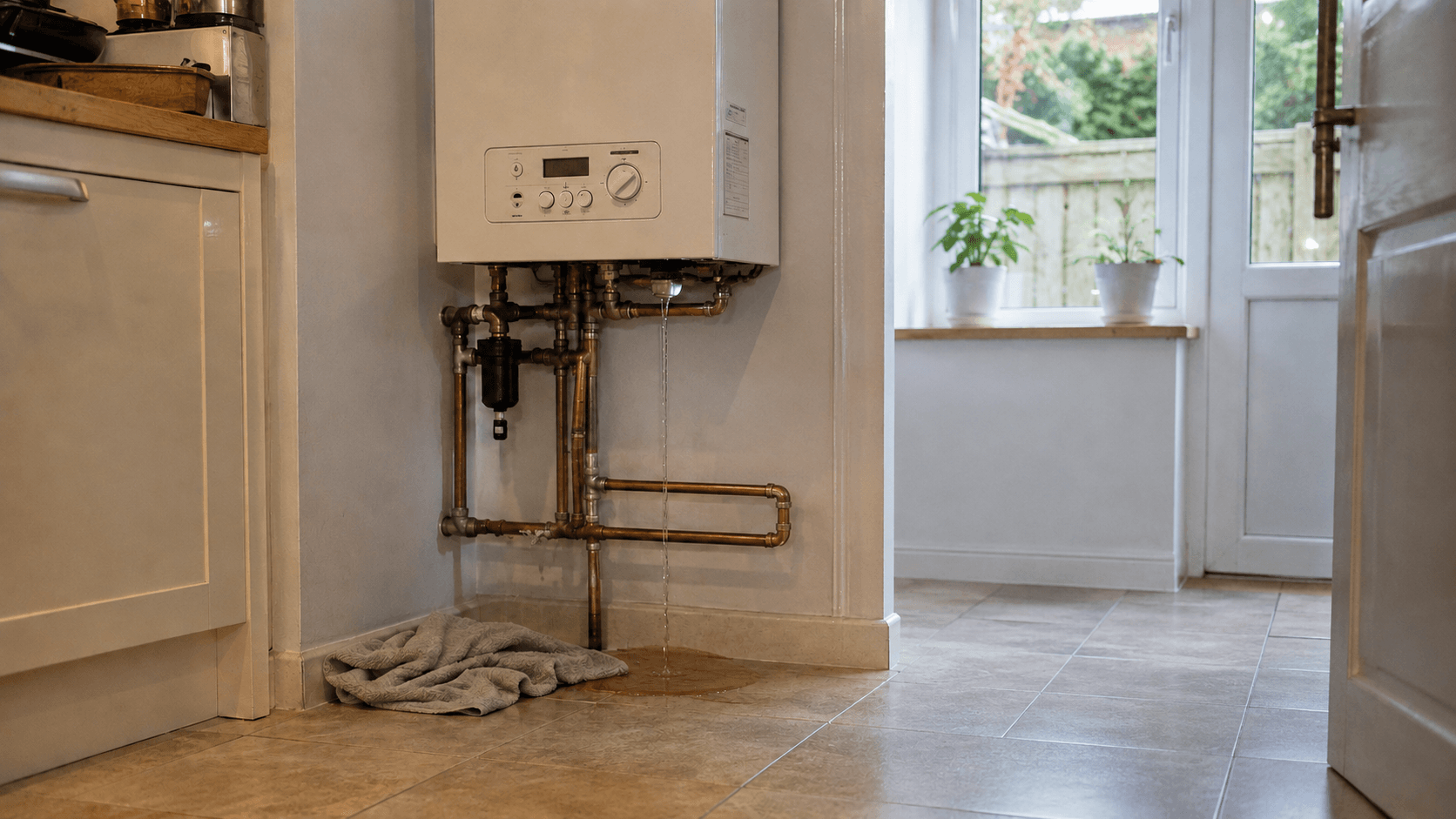
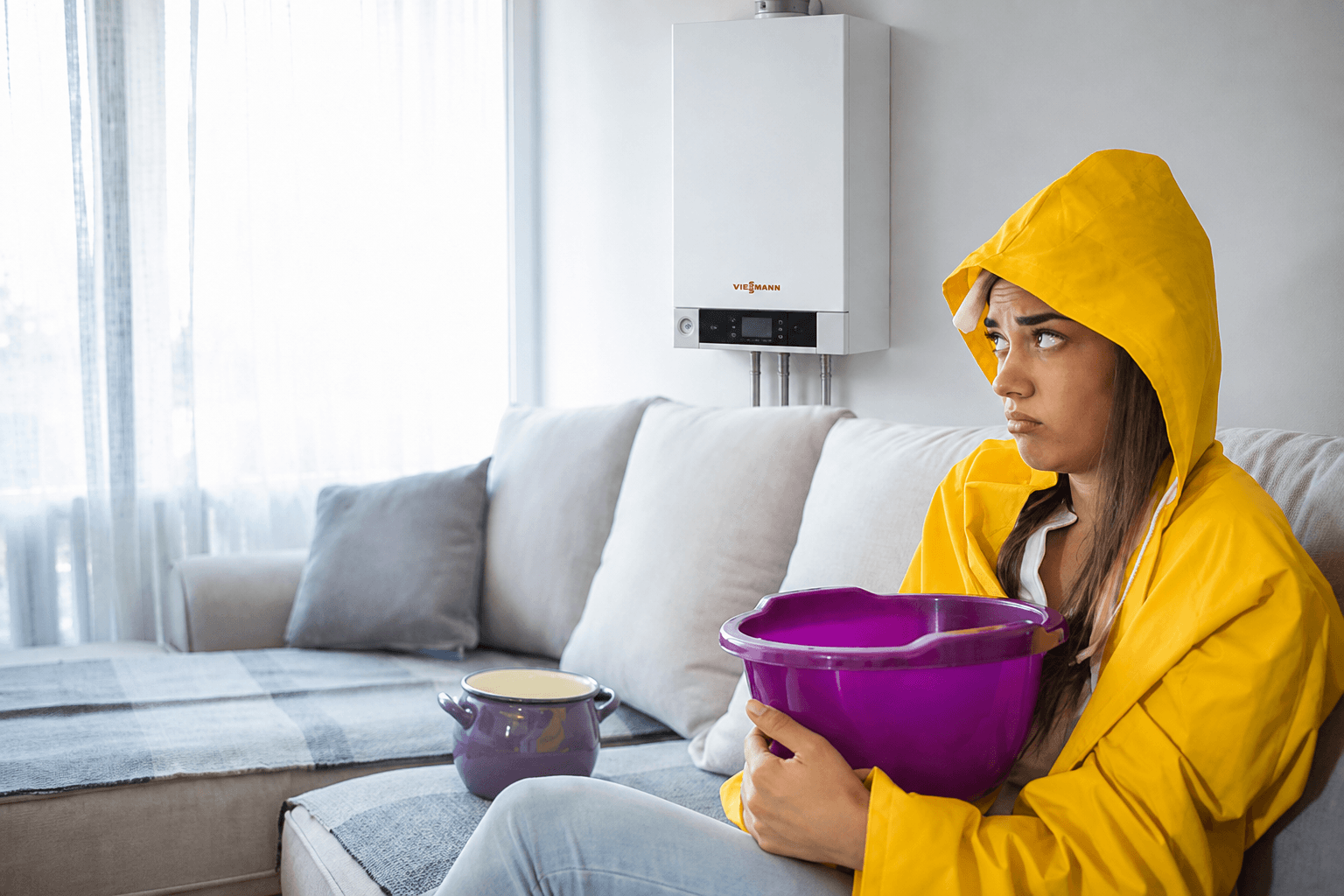
Finding water underneath your boiler is understandably worrying.
Sometimes it starts with a small drip. Other times, you notice a damp patch on the wall, water collecting inside a kitchen cupboard or a puddle spreading across the floor.
Whatever the size of the leak, a boiler leaking water should never be ignored. Water can damage internal electrical components, affect the operation of your heating system and cause further damage to your home if the problem continues.
The good news is that a leaking boiler does not automatically mean you need a replacement. Many leaks are caused by repairable faults, including worn seals, damaged pipe connections or problems with the pressure-relief system.
This guide explains what to do immediately, the most common reasons a boiler leaks water and when to call a qualified heating engineer.
What Should You Do If Your Boiler Is Leaking Water?
If you notice water dripping from your boiler or collecting underneath it, take these steps.
1. Check for Any Immediate Danger
Before touching anything, check whether:
- You can smell gas.
- Water has reached electrical sockets, switches or wiring.
- The leak is heavy or getting worse.
- You hear unusual hissing, banging or electrical noises.
- A carbon monoxide alarm is sounding.
If you smell gas, do not switch the boiler, lights or other electrical equipment on or off.
Open doors and windows if it is safe to do so, leave the area and call Gas Networks Ireland on 1800 20 50 50 from outside or away from the suspected leak. If you cannot get through, call 999 or 112. Gas Networks Ireland’s official safety guidance.
If a carbon monoxide alarm sounds, leave the property immediately and contact the emergency services.
2. Switch Off the Boiler If It Is Safe
If there is no smell of gas and the boiler controls are dry and safe to reach, switch off the boiler.
This helps prevent the system from continuing to heat and circulate water while the fault is investigated.
Do not touch electrical controls if water has reached them or if you would need to stand in water.
3. Contain the Leak
Place a bowl, tray or towels underneath the drip if you can do so safely.
Move nearby belongings away from the area and keep children and pets clear.
Remember that water may be hot, particularly if the boiler was recently operating.
4. Consider Turning Off the Water Supply
If water is flowing heavily and you can safely access your home’s main stopcock, turning off the incoming water supply may help limit damage.
However, this will not necessarily stop every boiler leak. Some leaks come from water already inside the sealed heating system, so water may continue escaping even after the mains supply is turned off.
Avoid guessing which valves or pipes to adjust beneath the boiler. If you are unsure, leave them alone and call a heating engineer.
5. Arrange a Professional Inspection
A qualified engineer can identify where the water is coming from and whether the boiler can be repaired safely.
For gas boilers in Ireland, work on the appliance or gas pipework should be carried out by a Registered Gas Installer, commonly referred to as an RGI. Gas Networks Ireland states that an RGI must be used for installation, servicing, safety checks, repairs or removal of gas appliances or pipework.
If the leak is substantial, worsening or affecting electrical equipment, seek emergency boiler repair in Dublin.
Is a Boiler Leaking Water Dangerous?
A water leak does not automatically mean your boiler is about to fail catastrophically, but it can still present genuine risks.
Boilers contain electrical components, hot water and, in the case of gas boilers, a gas supply. Allowing water to enter parts of the appliance where it should not be can create safety problems and cause additional damage.
Potential consequences include:
- Damage to electrical components.
- Corrosion inside the boiler.
- Damage to flooring, walls, kitchen units or ceilings.
- Falling heating-system pressure.
- Loss of heating or hot water.
- A minor fault developing into a more expensive repair.
A water leak is not the same thing as a gas leak. However, if you notice both water and the smell of gas, treat it as a gas emergency and follow the safety steps above.
Why Is My Boiler Leaking Water?
Several different faults can cause a boiler to leak. The exact cause depends on where the water appears, when the leak happens and the condition of the appliance.
1. Worn Seals or Internal Joints
Boilers contain seals, washers and connections designed to keep water inside the heating system.
Over time, these components can deteriorate because of heat, age and normal wear.
A worn seal may allow small amounts of water to escape, often producing:
- A slow drip.
- Damp marks beneath the boiler.
- Water collecting inside the boiler casing.
- Occasional leaking when the system heats up.
In many cases, replacing the affected seal or component resolves the problem.
However, accessing internal boiler parts is a job for a qualified engineer.
2. A Leaking Pipe or Connection
Sometimes the boiler itself is not the source of the leak.
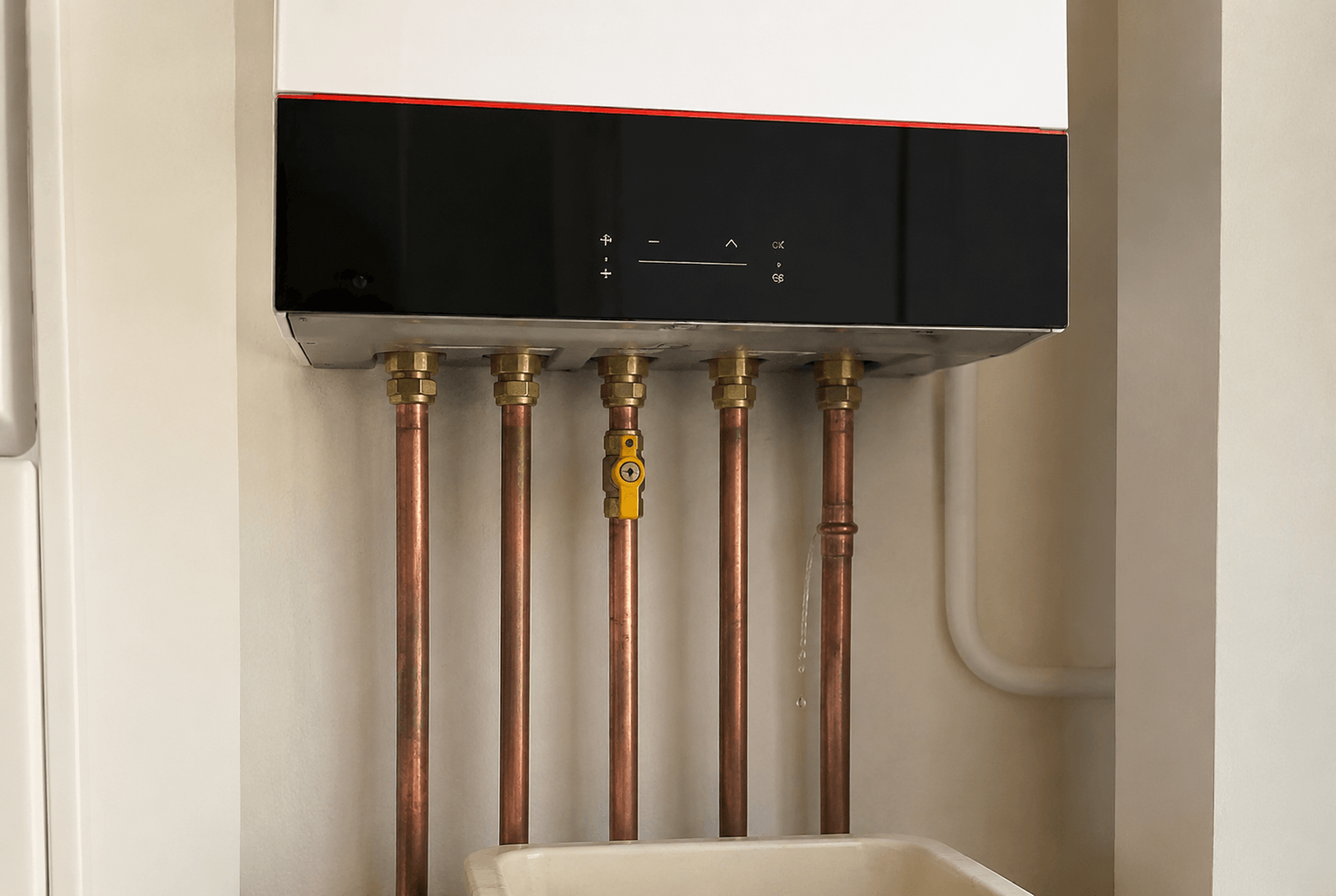
The problem may be a pipe, fitting or valve directly beneath the appliance.
Heating pipes expand and contract as their temperature changes. Over time, connections can loosen, seals can wear and older pipework can corrode.
You may notice the leak becoming more obvious when the heating switches on or after the boiler has been running for a while.
Even if a connection appears easy to reach, avoid tightening fittings yourself. Applying too much force can damage the connection or make the leak worse.
3. A Faulty Pressure-Relief Valve
A pressure-relief valve is a safety component designed to release water when pressure inside the heating system becomes too high.
That discharge normally travels through a dedicated pipe, often exiting through an outside wall.
If the valve opens repeatedly, becomes contaminated with debris or fails to close properly afterwards, water may continue dripping from the discharge pipe.
The important point is that a pressure-relief valve is doing a safety job. It should never be blocked, sealed or tampered with.
If you also notice your pressure gauge changing regularly, read our separate guide on why boiler pressure keeps dropping.
4. Problems With the Condensate Pipe
Modern condensing boilers produce a small amount of wastewater called condensate.
This is normal. The condensate should travel safely through a dedicated pipe to a suitable drain.
A problem can occur if that pipe becomes:
- Blocked.
- Disconnected.
- Damaged.
- Frozen during cold weather.
- Restricted by a poorly fitted or kinked section.
If condensate cannot drain correctly, it may back up or escape around a connection near the boiler.
Water running through the condensate system is expected; water dripping from a loose joint or collecting underneath the boiler is not.
5. A Damaged Pump Seal
The circulation pump moves heated water around your central-heating system.
If a pump seal deteriorates, water may leak around the pump housing or nearby connections.
Depending on your setup, the pump may be inside the boiler or elsewhere in the heating system.
You might also notice changes in heating performance, unusual noises or radiators taking longer to warm up.
An engineer can determine whether the seal can be replaced or whether the pump itself needs attention.
6. Corrosion or a Damaged Heat Exchanger
The heat exchanger transfers heat into the water circulating through your system.
If it becomes corroded, cracked or damaged, water can leak inside the boiler.
This is generally more serious than a worn washer or loose connection because the heat exchanger is a major component.
Whether repair makes sense will depend on the boiler’s age, condition, warranty and the availability of replacement parts.
A leaking heat exchanger does not always mean the entire boiler must be replaced, but it does require prompt professional assessment.
7. An Expansion Vessel Problem
An expansion vessel helps manage changes in pressure as water heats up and expands.
If it loses its charge or develops a fault, system pressure may rise more than expected while the heating is running.
This can cause the pressure-relief valve to discharge water, sometimes producing an intermittent leak that appears only when the system is hot.
The visible leak may therefore be a symptom of another underlying component fault.
Boiler Leaking Water From Underneath: What Does It Mean?
A leak coming from underneath a boiler does not have to be a problem with the boiler itself.
A leak from under a boiler does not mean the problem is under the boiler. A leak from under a boiler could well be a drip from the top of the boiler running down the back of the boiler.
Common possibilities include:
- A worn internal seal.
- A leaking pump or connection.
- A damaged condensate pipe.
- A problem with the filling loop.
- Corrosion inside the boiler.
- A leaking heat exchanger.
A small puddle of water under your boiler could be worth checking out.
Do not try to diagnose a leak by removing the casing of your boiler. A properly qualified engineer can diagnose a leak and repair your boiler safely.
Why Does My Boiler Only Leak When the Heating Is On?
Some boiler leaks only appear to leak while the heating is on.
This is because as the water in the pipes heats up it can expand. This can put excess pressure on the pipes. As a result, the connections to the pipes can move. A small weakness in a boiler’s seal etc. may not leak when the system is cold but open up when everything has warmed up.
Leaks often occur when the system is under pressure. A small weakness in a boiler that does not leak when cold, can leak when the system is hot. As the water in the boiler is heated it expands. There is increased pressure in the system. The connections in the pipes can move.
Possible causes include:
- A worn seal opening slightly as components heat up.
- A loose connection affected by expansion.
- Excess pressure triggering the pressure-relief valve.
- A faulty expansion vessel.
- A pump or internal component leaking during operation.
Even though the leak has stopped when the heating has been switched off, the cause of the leak still needs to be investigated and repaired.
It’s also important to remember not to test the leak by switching the boiler on and off in order to see if the leak returns.
Can You Still Use a Boiler That Is Leaking?
The safest approach is not to continue using a leaking boiler until it has been inspected.
Even a small leak can worsen, especially when the boiler heats up or pressure increases.
Continued use may also allow water to reach electrical components or cause damage that would otherwise have been avoidable.
If you are unsure whether the leak is coming from the boiler, nearby pipework or another appliance, arrange a professional inspection before using the system again.
Can You Fix a Leaking Boiler Yourself?
There are a few sensible steps you can take as a homeowner:
- Switch off the boiler if it is safe.
- Place a container underneath the leak.
- Turn off the mains water supply if appropriate and safe.
- Note where the water is appearing.
- Photograph the leak from a safe distance.
- Contact a qualified engineer.
However, you should not:
- Remove the boiler casing.
- Attempt to repair internal components.
- Tighten unfamiliar valves or pipe connections.
- Block the pressure-relief discharge pipe.
- Repeatedly top up the system while water is visibly escaping.
- Continue using the boiler to see whether the leak stops.
- Interfere with gas pipework or electrical wiring.
For a gas boiler, repairs should be carried out by a Registered Gas Installer.
When Should You Call a Heating Engineer?
A heating engineer should inspect any visible boiler leak, even if it seems minor.
Arrange urgent assistance if:
- Water is dripping steadily or pooling underneath the boiler.
- The leak is getting worse.
- Water is close to electrical sockets, switches or wiring.
- Your heating or hot water has stopped working.
- The boiler displays a fault code.
- The leak returns whenever the heating switches on.
- The boiler has visible rust or corrosion.
- The appliance has developed several recent faults.
If you smell gas, call Gas Networks Ireland on 1800 20 50 50 first.
Otherwise, contact a professional gas boiler repair engineer in Dublin to identify the problem and advise on the appropriate repair.
Does a Leaking Boiler Need to Be Replaced?
Not necessarily.
Many boiler leaks can be repaired by replacing a seal, valve, pump component or damaged section of pipework.
Replacement is more likely to be worth considering if:
- The boiler is older and has a history of repeated breakdowns.
- The heat exchanger has failed.
- There is extensive internal corrosion.
- Replacement parts are difficult to obtain.
- Several major components need attention.
- The appliance is becoming unreliable despite repeated repairs.
The right decision depends on the overall condition of the boiler, not simply whether water is leaking.
For more guidance, read our article on whether to repair or replace your boiler.
If replacement is recommended, explore NRM’s gas boiler replacement services in Dublin.
How Can You Prevent Boiler Leaks?
Not every leak can be prevented, but regular maintenance helps identify developing faults before they become more serious.
Practical steps include:
- Arrange an annual boiler service.
- Watch for damp marks, rust or water around pipe connections.
- Pay attention to unusual changes in heating performance.
- Avoid repeatedly topping up a system that keeps losing pressure.
- Have small drips investigated before they become larger leaks.
- Ensure gas boiler servicing and repairs are carried out by an RGI.
Both Gas Networks Ireland and the Registered Gas Installers scheme recommend having gas boilers serviced regularly by a Registered Gas Installer.
Frequently Asked Questions
Is a boiler leaking water an emergency?
It can be, particularly if the leak is heavy, close to electrical components, causing property damage or accompanied by a smell of gas.
A small drip may not require emergency services, but it still needs prompt inspection by a qualified engineer.
Why is my boiler leaking water from the bottom?
Water dripping from the bottom of a boiler may be caused by a worn seal, leaking pipe connection, faulty pump, condensate issue or damaged internal component.
Because water can travel inside the appliance before appearing underneath, the visible drip does not always identify the actual source.
Should I turn off my boiler if it is leaking water?
Yes, provided there is no smell of gas and the controls are dry and safe to reach.
If you smell gas, do not touch electrical switches. Leave the area and call Gas Networks Ireland on 1800 20 50 50.
Can a leaking boiler still work?
Yes. A boiler may continue producing heating or hot water despite a leak, particularly if the fault is minor.
However, continuing to use it can increase the risk of further damage, so the appliance should be checked before normal use resumes.
Does a boiler leaking water mean carbon monoxide is leaking?
Not necessarily. A water leak and carbon monoxide leak are different problems.
However, any boiler fault should be taken seriously, and a working carbon monoxide alarm provides an important additional safety measure.
If a carbon monoxide alarm sounds, leave the property and contact the emergency services.
Can I top up the pressure if my boiler is leaking?
Repeatedly topping up a boiler when water is visibly escaping does not solve the underlying fault and may make the leak worse.
Switch off the boiler if it is safe and arrange an inspection instead.
If your main issue is pressure loss without a visible boiler leak, see our guide to boiler pressure problems.
Who should repair a leaking gas boiler in Ireland?
A leaking gas boiler should be assessed and repaired by a Registered Gas Installer.
An RGI has the appropriate qualifications and registration to carry out work on domestic gas appliances safely.
Need Help With a Boiler Leaking Water?
If your boiler is leaking water, do not wait for a small drip to become a bigger problem.
NRM Plumbing & Heating can investigate the cause, explain the available options and recommend the most appropriate repair.
Whether the issue involves a leaking connection, faulty valve, damaged component or an older boiler that may need replacement, our experienced team can help you take the next step with confidence.
Call NRM Plumbing & Heating on 01 535 29 48 or 087 990 89 13 to arrange a boiler inspection or repair in Dublin.
Are your Radiators Hot When the Heating Is Off? here’s What to Do



Leave A Comment